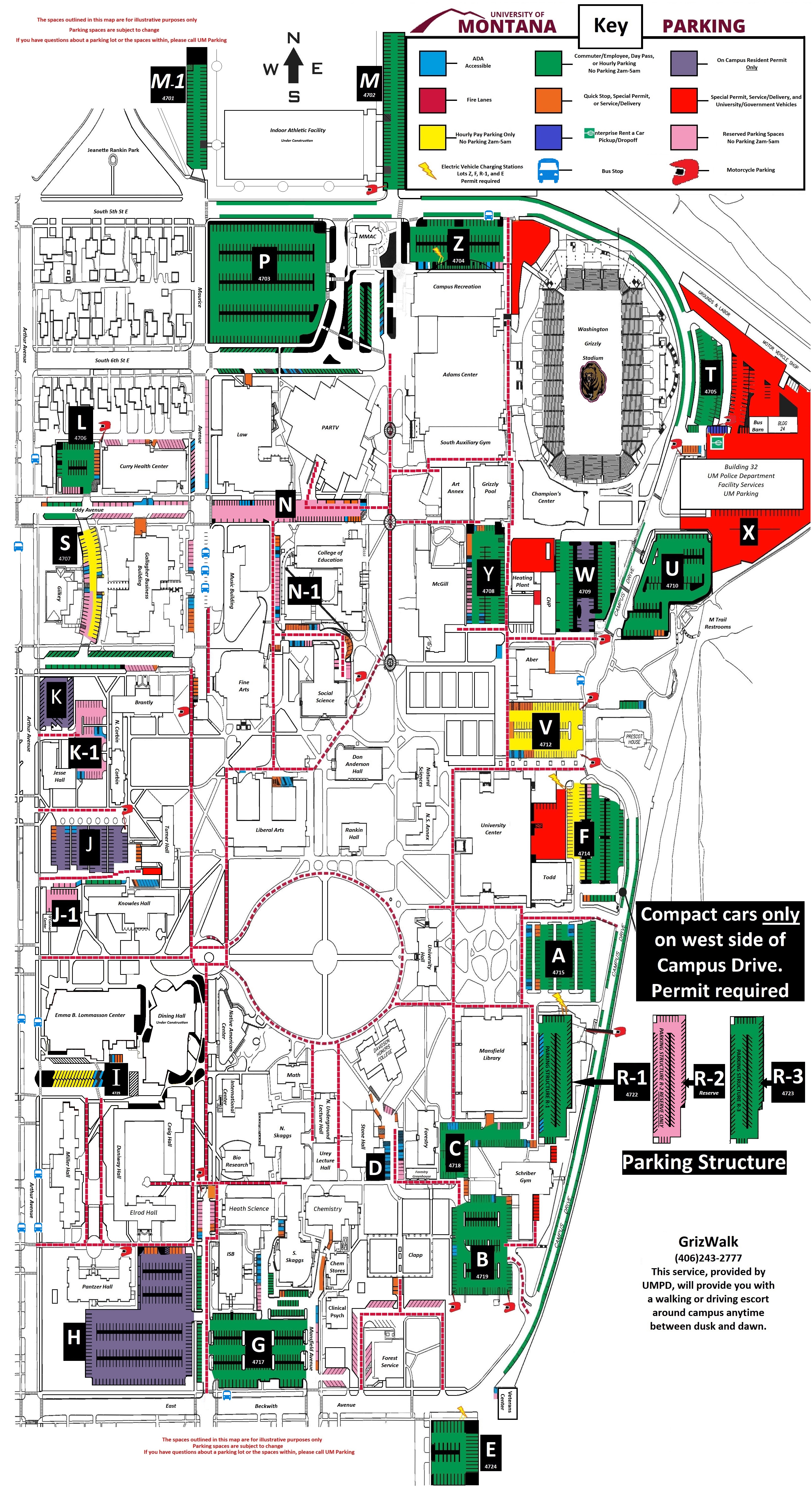
Parking for Thursday Evening: The Summit begins at 4:00. You can use the Adams Center parking lot (LOT P on the map). The Passport app system is available to pay for short-term parking. If you are arriving at 5:00 or later, parking on campus is Free.
4/17 Friday Sessions: All Friday sessions will be held in the PJW College of Education, except for two held in adjacent buildings (signage will be displayed). Breakfast will begin at 8:00, and sessions will start promptly at 8:30.
4/18 Saturday Sessions: All Saturday sessions will take place in the PJW College of Education. Breakfast and registration will be available as early as 7:30 am. Sessions will begin at 8:15. Parking for Saturday Sessions: All parking is FREE. You may park anywhere on campus!
Travel: For those traveling from outside Missoula, book your hotel early! A limited number of discounted hotel rooms are available on a first-come, first-served basis at the Holiday Inn Missoula Downtown. You can use this link to book your rooms.Please usethe code ECE or call the hotel at 406-721-8550 and mention the code and ECE 4th Annual Summit.
Sign up or log in to add sessions to your schedule and sync them to your phone or calendar.
**ECP Credit Available** Session Description: Building on the progression of partitioning in Grades K-2, participants will learn approaches to conceptualizing and formalizing fraction notation in Grade 3. We will begin by applying counting skills used with whole numbers to the counting of fractions. By counting unit fractions learners develop an understanding of the role the numerator plays in a fraction. We will count together and discuss the role mathematical language plays in our understanding of fractions and see how this understanding leads to development of fraction operations without the need to teach a standard algorithm. Participants will then make and play a fraction game that supports learner development of part, whole, and equivalent parts in the context of fractions through use of a length model. The presenter will share how the game is used in a third-grade classroom to introduce, reinforce, and extend student thinking about fractions.
In this session participants will: 1. Connect whole number counting to counting fractions. 2. Understand how counting fractions develops understanding of fraction concepts and operations. 3. Use games to model and understand fraction concepts of whole, parts, and equivalent parts.
**ECP Credit Available** Session description: Engage students in number sense and estimation activities using a process of revealing, reflecting, and adjusting. We will explore three math routines that utilize 'Slow Reveal' to spark joy and build reasoning skills: numberless word problems, math detective mysteries, and estimation activities known as Esti-mysteries. Number sense is a process which develops slowly as a result of exploring numbers and visualizing them in different contexts; it grows as students make connections. (Van de Walle et al. 2018) Come join us for some fun number sense activities that you can use in the K-3 classroom.
In this session, participants will:
Practice the use of slow reveal with numberless word problems to clarify contextual problems and build awareness of number quantities.
Explore how slow reveal can be used with Esti-Mysteries to develop benchmarks for estimating
Develop their own clues to Math Detective Mysteries to explore various attributes of numbers.
Building Blocks for Teaching Young Children in Inclusive Settings
Do you have children in your early learning environments with diverse learning needs? This could be children with complex disabilities such as autism, to those who present with mild learning disabilities. If so, this workshop is for you! Grounded in the framework, Building Blocks for Teaching Young Children in Inclusive Settings, a tiered system of support that includes curriculum modifications, embedded learning opportunities, and child focused instructional strategies, participants will learn how to embed simple, effective individualized support within everyday routines and activities, ensuring all children can meaningfully participate alongside their peers. This evidence-based framework was developed by researchers at the University of Washington and is based on over fifty years of research in best practices for inclusive settings. Additionally, this workshop includes a discussion from the field! Hear from teachers at the Learning and Belonging (LAB) School that are implementing this framework.
Attendees will:
1. Gain an understanding of the Building Blocks framework, a tiered system of support for children in inclusive, early learning environments.
2. Name several types of curriculum modifications and accommodations and learn how to plan for individual children with a simple modification/accommodation matrix.
3. Describe embedded learning opportunities and learn how to plan for intentional learning to support individual children with these opportunities.
4. Leave with practical strategies for implementing the Building Blocks framework in their early learning environments to support all learners.
Presenter: Julie Ashmun, Education Specialist from the Haring Center for Inclusive Education at the University of Washington. Julie’s work focuses on coaching, consultation, and professional development for early learning, school and center-based teachers and leaders working to improve inclusive education practices.
****We'll raffle off 10 copies of the Building Blocks for Inclusive Classrooms text*****