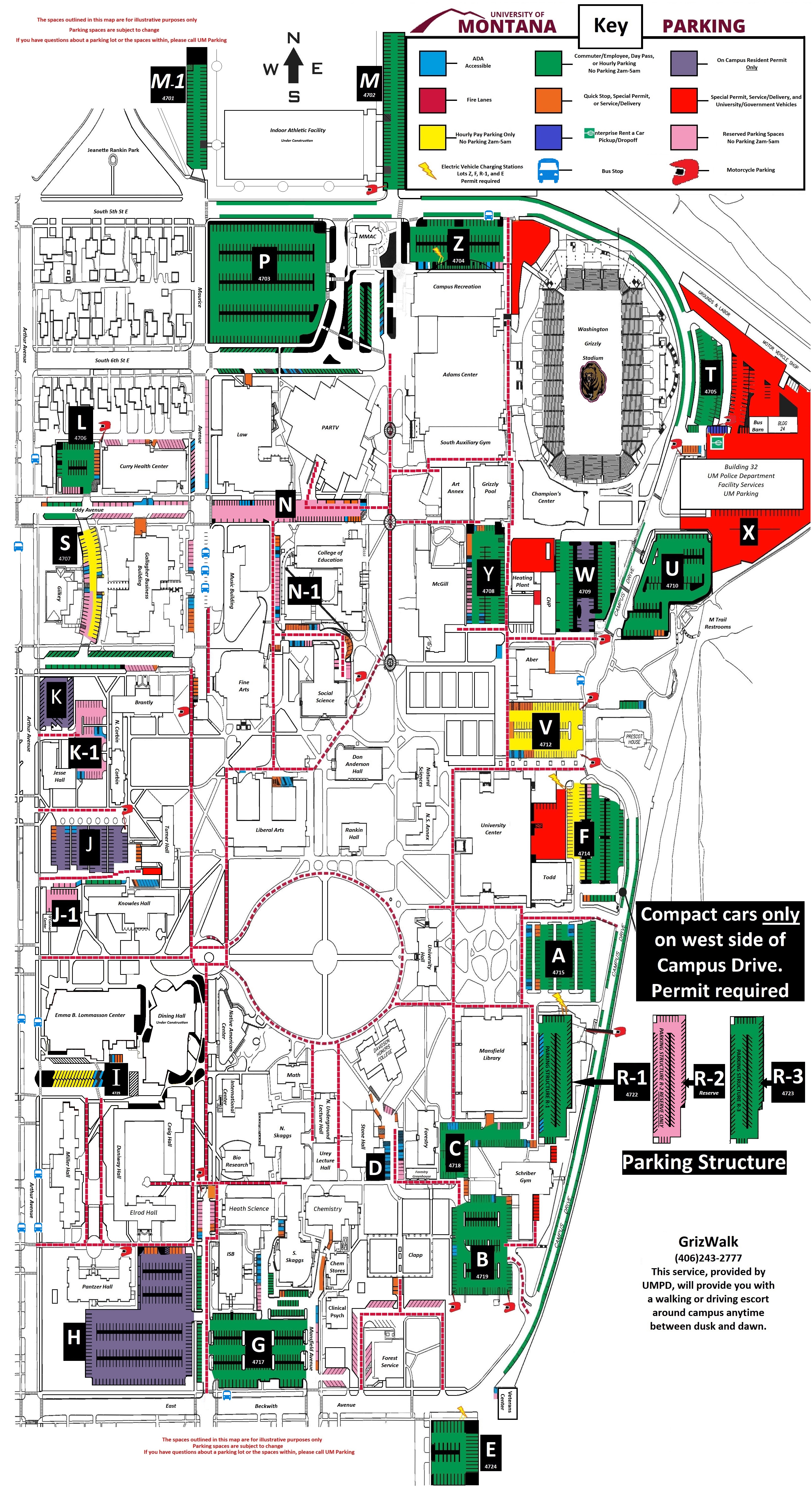
Parking for Thursday Evening: The Summit begins at 4:00. You can use the Adams Center parking lot (LOT P on the map). The Passport app system is available to pay for short-term parking. If you are arriving at 5:00 or later, parking on campus is Free.
4/17 Friday Sessions: All Friday sessions will be held in the PJW College of Education, except for two held in adjacent buildings (signage will be displayed). Breakfast will begin at 8:00, and sessions will start promptly at 8:30.
4/18 Saturday Sessions: All Saturday sessions will take place in the PJW College of Education. Breakfast and registration will be available as early as 7:30 am. Sessions will begin at 8:15. Parking for Saturday Sessions: All parking is FREE. You may park anywhere on campus!
Travel: For those traveling from outside Missoula, book your hotel early! A limited number of discounted hotel rooms are available on a first-come, first-served basis at the Holiday Inn Missoula Downtown. You can use this link to book your rooms.Please usethe code ECE or call the hotel at 406-721-8550 and mention the code and ECE 4th Annual Summit.
Sign up or log in to add sessions to your schedule and sync them to your phone or calendar.
Understand how cross-sector collaboration strengthens existing efforts and builds scaffolding to improve early learning quality throughout the state.
Identify connection points that could align early education efforts as participants are invited participants to see themselves and others in the Network.
Recognize the role of networks in reducing silos, burnout, and fragmentation in the early childhood education system.
Understand how play functions as a serious learning strategy that supports cognitive development, self-regulation, literacy, and numeracy across Birth–3rd grade.
Explore aligned P–3 instructional practices that bridge early childhood and early elementary learning through shared language, routines, and developmental expectations.
Experience Ray’s “Diamond Model of Learning,” which frames curiosity, mistakes, and imagination as essential building blocks for deep understanding.
Gain practical, classroom-ready strategies for designing guided play and inquiry experiences that connect early learning and early grades.
Reflect on how joyful learning strengthens relationships, equity, and coherence across classrooms, schools, and community systems.
**ECP Credit Available** Session Description: Building on the progression of partitioning in Grades K-2, participants will learn approaches to conceptualizing and formalizing fraction notation in Grade 3. We will begin by applying counting skills used with whole numbers to the counting of fractions. By counting unit fractions learners develop an understanding of the role the numerator plays in a fraction. We will count together and discuss the role mathematical language plays in our understanding of fractions and see how this understanding leads to development of fraction operations without the need to teach a standard algorithm. Participants will then make and play a fraction game that supports learner development of part, whole, and equivalent parts in the context of fractions through use of a length model. The presenter will share how the game is used in a third-grade classroom to introduce, reinforce, and extend student thinking about fractions.
In this session participants will: 1. Connect whole number counting to counting fractions. 2. Understand how counting fractions develops understanding of fraction concepts and operations. 3. Use games to model and understand fraction concepts of whole, parts, and equivalent parts.
This panel showcases how joyful literacy is taking shape across Montana—from the research behind shared book reading, to community leadership networks, to innovative partnerships that embed language-rich learning opportunities in everyday spaces.
Facilitator: Dr. Kate Brayko, University of Montana Professor of Literacy
1. The Research is In! Dolly Parton's Imagination Library Reinforces the Power of Shared Book Reading Attendees will leave with (1) an understanding of how Imagination Library reinforces the power of shared book reading, (2) key findings on a groundbreaking international research study of the Imagination Library, and (3) why this research matters for Montana families. 2. The Early Learning Fellows Model (stories from Missoula and Gallatin Counties)
This spotlight will (1) explore the Early Learning Fellows model as a community-driven approach to strengthening early childhood systems through local leadership and collaboration, (2) showcase stories from Missoula and Gallatin Counties that illustrate how cross-sector partnerships are supporting young children, families, and early educators, and (3) reflect on opportunities in your own community to build relationships, align efforts, and advance shared responsibility for early learning. 3. Project ELLO: Everyday Language and Learning Opportunities
The ELLO team will showcase (1) the purpose and design of Project ELLO and how partnerships with Parks & Recreation and Community Health organizations can extend language-rich learning into everyday community spaces, (2) implementation examples that highlight how cross-sector partners are embedding simple prompts, visuals, and playful interactions in parks, recreation programs, and community settings to support young children’s language and learning, and (3) opportunities for collaboration in your own community to create accessible, language-rich environments that support children and families through everyday experiences.
Identify the shift from access to belonging: By the end of the session, participants will be able to name three specific ways their program can move from simply providing a space for a child to ensuring that they feel a true sense of belonging in the group.
Create simple changes for better support: Using real-life examples, participants will choose one common challenge, and with that challenge in mind, identify two practical ways to adapt a classroom setup or a daily routine to better support the unique needs of children with disabilities.
Build a path for collaborative partnership: Participants will brainstorm two concrete steps to strengthen ongoing communication and trust with families, ensuring that inclusive practices are build together and remain sustainable long after the initial transition into the program.
**ECP Credit Available** By the end of this session, participants will be able to:
Explain key principles of positive education and their relevance to wellbeing and learning in early childhood education and care settings.
Identify developmentally appropriate positive education practices that support young children’s curiosity, happiness, and social–emotional development.
Adapt and implement positive education practices based on children’s needs, while partnering with families to promote children’s wellbeing
**ECP Credit Available** Session description: The Sandbox Project is a collaboration between MonTECH and the Montana Department of Public Health and Human Services (DPHHS). It provides free training, coaching, and assistive technology kits to licensed childcare providers across Montana to help them implement: • Inclusive practices • Universal Design for Learning (UDL) • Assistive technology tools for children ages birth to five • Understandings in ways to add UDL’s to IEP’s • DIY-Easy on-hand items for adaptive
Tuesday July 21, 2026 9:30am - 10:20am MDT MonTECH
**ECP Credit Available** Session description: Engage students in number sense and estimation activities using a process of revealing, reflecting, and adjusting. We will explore three math routines that utilize 'Slow Reveal' to spark joy and build reasoning skills: numberless word problems, math detective mysteries, and estimation activities known as Esti-mysteries. Number sense is a process which develops slowly as a result of exploring numbers and visualizing them in different contexts; it grows as students make connections. (Van de Walle et al. 2018) Come join us for some fun number sense activities that you can use in the K-3 classroom.
In this session, participants will:
Practice the use of slow reveal with numberless word problems to clarify contextual problems and build awareness of number quantities.
Explore how slow reveal can be used with Esti-Mysteries to develop benchmarks for estimating
Develop their own clues to Math Detective Mysteries to explore various attributes of numbers.
Play isn't a break from learning; it is the engine of learning. However, many educators feel stuck between "free play" (which feels chaotic) and "direct instruction" (which feels rigid). This interactive workshop bridges that gap using the Spectrum of Play framework. Participants will begin with a 15-minute deep dive into the research-backed power of playful learning, identifying the five key characteristics that make an activity "playful": joy, meaning, active engagement, iteration, and social interaction. We will also explore the various “stops” along the spectrum of play and discus their relative strengths. The core of the session is a hands-on "Pedagogical Pivot." Participants will audit one of their own existing lessons, mapping it onto the spectrum and identifying opportunities to infuse it with greater agency and choice. By the end of the session, educators will walk away with a redesigned, playful lesson plan and a toolkit of strategies to move their practice toward Guided Play—the sweet spot where adult scaffolding meets child-led discovery. Learning Objectives
Deconstruct the nuances between free play, guided play, games, and direct instruction.
Evaluate a current learning activity using the five evidence-based characteristics of playful learning: joyful, meaningful, actively engaging, iterative, and socially interactive.
Synthesize pedagogical strategies to "pivot" a teacher-led activity into a guided play experience that maintains learning goals while increasing student agency.
**ECP Credit Available** Community Schools 101: Strengthening the Early Learning Fabric: A Continuum of Support through Community School Partnerships Description: For our youngest learners, success is rooted in the strength of the ecosystem surrounding them. This session frames the Community School Strategy as a powerful framework to align early childhood providers, families, and K-12 partners around a shared vision for child development. This approach helps communities integrate existing resources to ensure every child is healthy, supported, and ready to thrive. -Explore the strategy: Identify how Community School practices can help create a supportive ecosystem for early learning and development -Examine impact: See how this approach improves outcomes for early learners and their families - First steps: Identify "low-lift" strategies, such as basic asset mapping, to begin strengthening your school-community partnerships to enhance early learning and school systems.
Enjoy a hosted lunch, network with others, peruse spotlight posters, and hear the annual impact update from the UM Institute for Early Childhood Education.
Examine how leadership, professional development, resources, and cross-sector collaboration influence teacher preparedness for inclusive Birth-3rd-grade classrooms serving children with ASD, particularly in rural and underserved contexts.
Apply key components of the Teacher Preparedness for Autism Spectrum Disorder Framework (TPAF) to guide leadership decisions, professional learning, and inclusive instructional support across early childhood and K-3 systems.
Identify strategies to strengthen alignment among early childhood programs, K-3 classrooms, special education services, and family partnerships to support sustainable, inclusive learning environments.
This session is limited to 30 attendees. Attendees will receive a copy of the Strive for Five: Using Intentional Conversations to Build Early Language and Literacy text.
Attendees will:
Understand how multi-turn Strive-for-Five conversations support children’s oral language, comprehension, and early literacy development.
Use the five-turn conversation structure to move beyond simple question-and-answer exchanges and intentionally stretch children’s thinking and vocabulary.
Implement at least one Strive-for-Five strategy within everyday classroom routines such as read-alouds, play, or small-group instruction.
This panel highlights how Montana is designing the future of its early childhood system through cross-sector partnerships, workforce pathways, and strategic systems-building efforts. Presenters will share lessons from the Bright Futures B-5 initiative, innovative workforce development through the CDA Registered Apprenticeship program, efforts to strengthen infant and early childhood mental health and relational health, and tools that help professionals navigate Montana’s early care and education ecosystem. Together, these efforts illustrate how collaboration across agencies, institutions, and communities is shaping a stronger and more connected early childhood system for the future.
1. Bright Futures B-5: Sowing Seeds for the Future Participants will learn about the statewide systems-building efforts supported through Montana’s Bright Futures B-5 Preschool Development Grant and the lasting impact of this work on early childhood programs, services, and partnerships. Attendees will gain (1) an overview of the key focus areas and initiatives supported through the grant from 2023–2025, (2) insight into outcomes and promising practices emerging from pilots and projects—including home visiting, crisis care, workforce initiatives, and system tools—and the strategies being used to sustain this work beyond the life of the grant, and (3) an opportunity to reflect on how the early childhood landscape may evolve moving forward and what continued collaboration will mean for strengthening Montana’s early childhood system.
2. Montana CDA Registered Apprenticeship Participants will learn how Montana state agencies and higher education partners collaborated to design and implement a registered apprenticeship pathway leading to a Child Development Associate (CDA) credential for adult learners. Attendees will gain (1) an understanding of how the CDA registered apprenticeship model helps address Montana’s early childhood workforce needs by providing accessible, no-cost training and supportive pathways into the profession, (2) insight into the collaborative development of the program through partnerships among the Early Childhood Project, Early Childhood Services Bureau, Department of Labor and Industry, and Childcaretraining.org, and (3) practical knowledge of the program’s key components and opportunities to participate as an apprentice, mentor, or sponsor within the registered apprenticeship system.
3.. Healthy Mothers, Healthy Babies: Infant Early Childhood Mental Health and Early Relational Health Participants will explore the importance of Infant and Early Childhood Mental Health (IECMH) and Early Relational Health (ERH) as foundations for lifelong health, development, and well-being. Attendees will gain (1) an understanding of the core concepts of Infant and Early Childhood Mental Health and why early relationships serve as a critical protective factor for young children, (2) insight into the role of Early Relational Health and cross-sector collaboration in supporting families, caregivers, and early childhood professionals, and (3) an overview of how IECMH is being advanced in Montana—including current initiatives, consultation models, and the emerging Association for Infant Mental Health—along with opportunities for stakeholders to engage in strengthening early relational health statewide.
4. Better Together: The Montana ECE Ecosystem (DPHHS ECSB Team) Participants will explore Montana’s early care and education ecosystem and the many ways professionals contribute to supporting young children and families across the state. Attendees will gain (1) a deeper understanding of Montana’s early care and education system and the interconnected network of programs, services, and partners that support children’s development, (2) familiarity with Montana’s “ECE Trifecta of Tools”—the Montana Early Learning Standards, the Montana Early Childhood Education Knowledge Base, and the Montana ECE Career Workbook—and how these resources support professional practice and career development, and (3) opportunities to reflect on how their own work intersects with the broader system and how to access and utilize these tools to strengthen their impact.
This panel showcases community-driven efforts across Montana that support families before and during times of stress. Participants will learn how statewide prevention initiatives, crisis care models, and inclusive community spaces work together to strengthen families and promote safe, nurturing environments for children.
Facilitator: Brianne Moline, National Association for Family Child Care, Professional Development Specialist
1. From Prevention to Partnership: Strengthening Families and Protecting Montana’s Children Montana Children's Trust Fund 2. Strengthening Families through Crisis Child Care: Prevention, Support, and Statewide Impact Toby's House Crisis Nursery Participants will learn about Montana’s statewide approach to strengthening families and preventing child abuse and neglect through community partnerships and practical supports. Attendees will gain (1) an understanding of the Montana Children’s Trust Fund and its role in supporting prevention efforts and family well-being across the state, (2) insight into current initiatives and projects that build community capacity and promote protective factors for families, and (3) a deeper understanding of crisis care models—including crisis nurseries and related family supports—and how communities can collaborate to address gaps, provide essential resources, and help families navigate challenging times.
3. Play, Belonging, and Community: Creating Safe Spaces for Children and Families Missoula Food Bank and Empower Place Community Center Participants will explore how a community-centered play space connected to a food bank can serve as a model for belonging and inclusion. Attendees will learn (1) strategies for building community within nonprofit settings by creating spaces where families naturally gather and connect, (2) approaches for designing safe, welcoming environments that support children and families from a wide range of backgrounds and experiences, and (3) ways organizations can listen, adapt, and evolve their programs in response to the changing needs of the communities they serve.
Building Blocks for Teaching Young Children in Inclusive Settings
Do you have children in your early learning environments with diverse learning needs? This could be children with complex disabilities such as autism, to those who present with mild learning disabilities. If so, this workshop is for you! Grounded in the framework, Building Blocks for Teaching Young Children in Inclusive Settings, a tiered system of support that includes curriculum modifications, embedded learning opportunities, and child focused instructional strategies, participants will learn how to embed simple, effective individualized support within everyday routines and activities, ensuring all children can meaningfully participate alongside their peers. This evidence-based framework was developed by researchers at the University of Washington and is based on over fifty years of research in best practices for inclusive settings. Additionally, this workshop includes a discussion from the field! Hear from teachers at the Learning and Belonging (LAB) School that are implementing this framework.
Attendees will:
1. Gain an understanding of the Building Blocks framework, a tiered system of support for children in inclusive, early learning environments.
2. Name several types of curriculum modifications and accommodations and learn how to plan for individual children with a simple modification/accommodation matrix.
3. Describe embedded learning opportunities and learn how to plan for intentional learning to support individual children with these opportunities.
4. Leave with practical strategies for implementing the Building Blocks framework in their early learning environments to support all learners.
Presenter: Julie Ashmun, Education Specialist from the Haring Center for Inclusive Education at the University of Washington. Julie’s work focuses on coaching, consultation, and professional development for early learning, school and center-based teachers and leaders working to improve inclusive education practices.
****We'll raffle off 10 copies of the Building Blocks for Inclusive Classrooms text*****
**ECP Credit Available** Tired of the same old read-aloud routines? Ready to reimagine literacy through the power of the arts? Tiny Toy Tales transforms beloved children’s literature into immersive, arts-integrated storytelling experiences that ignite imagination and deepen comprehension. Using familiar titles stories are thoughtfully adapted into dynamic performances using tiny toys, handcrafted props, and visual tableaux. In this workshop, participants will observe a Tiny Toy Tale, receive the materials to make their own, and have time to assemble it! Come ready to create, collaborate, and bring stories to life—one tiny prop at a time! Learning outcomes: Participants will be able to design and construct an arts-integrated storytelling experience using miniature props and visual tableaux. Participants will analyze how arts-based adaptations of children’s literature can enhance student engagement and comprehension. Participants will apply creative storytelling techniques to transform familiar texts into interactive, performance-based literacy activities.
**ECP Credit Available** University Assisted Community Schools: Growing Together: Strengthening Early Childhood Systems Through University-Assisted Community Schools Early childhood is the foundational stage for all future learning, yet the weight of supporting both students and their families often falls solely on educators. This 101-level session introduces the University-Assisted Community School (UACS) model—a collaborative approach where higher education institutions partner with early learning and school systems to provide sustained support. Rather than a temporary project, this model creates a "win-win" ecosystem: universities provide expertise, student interns, and resources, while early childhood and school systems gain the capacity to better serve the whole child. We’ll explore how these partnerships can help achieve goals for student and family success by leveraging the unique assets of local or regional colleges and universities. · -The UACS Basics: Understand the core principles of the University-Assisted model and how it differs from traditional school partnerships. · -Mutual Benefits: Explore how university resources can align additional resources, expertise, and capacity to support early learning and school systems. · -Starting the Conversation: Identify practical ways to begin identifying and engaging potential higher education partners in your community to build a more supportive fabric for our youngest learners.
Identify research-aligned outdoor strategies that support early literacy development across foundational skills (letter knowledge, phonological awareness, early decoding) as well as oral language, vocabulary, and knowledge building.
Analyze outdoor learning environments to recognize opportunities for playful, purposeful literacy instruction that integrates movement, exploration, and meaningful talk.
Design a personalized outdoor literacy plan using their own school maps or nearby community spaces to support sustained early reading development.
Interested in exploring Missoula? Head downtown for the city’s self-guided ArtWalk, or hike the MTrail.These optional activities offer a chance to enjoy the local culture and the opportunity to connect and unwind with colleagues.