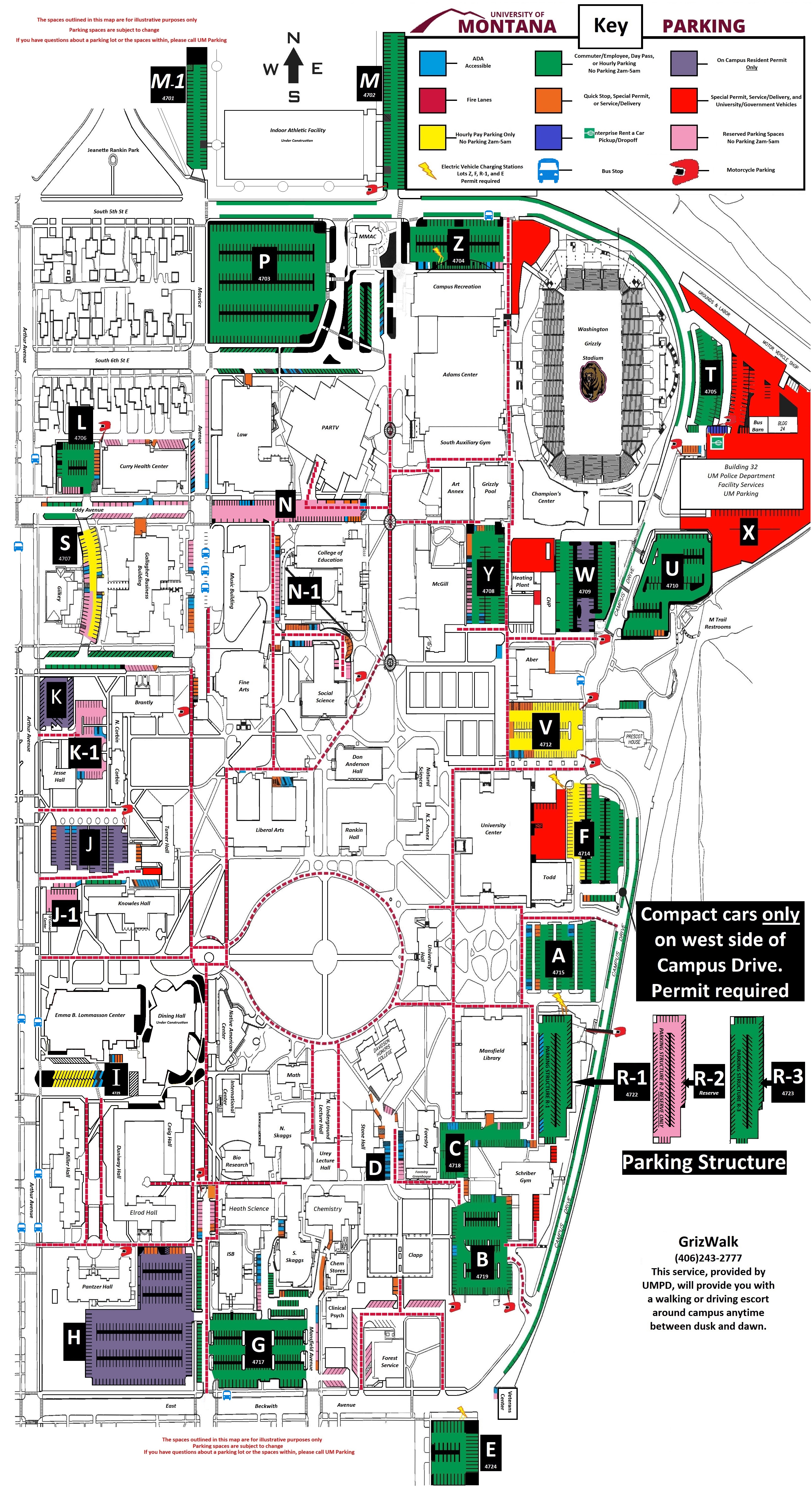
Parking for Thursday Evening: The Summit begins at 4:00. You can use the Adams Center parking lot (LOT P on the map). The Passport app system is available to pay for short-term parking. If you are arriving at 5:00 or later, parking on campus is Free.
4/17 Friday Sessions: All Friday sessions will be held in the PJW College of Education, except for two held in adjacent buildings (signage will be displayed). Breakfast will begin at 8:00, and sessions will start promptly at 8:30.
4/18 Saturday Sessions: All Saturday sessions will take place in the PJW College of Education. Breakfast and registration will be available as early as 7:30 am. Sessions will begin at 8:15. Parking for Saturday Sessions: All parking is FREE. You may park anywhere on campus!
Travel: For those traveling from outside Missoula, book your hotel early! A limited number of discounted hotel rooms are available on a first-come, first-served basis at the Holiday Inn Missoula Downtown. You can use this link to book your rooms.Please usethe code ECE or call the hotel at 406-721-8550 and mention the code and ECE 4th Annual Summit.
Sign up or log in to add sessions to your schedule and sync them to your phone or calendar.
Describe how leadership development programs can support family child care providers in building collaborative professional networks.
Identify key strategies for transforming leadership training into community-based initiatives that strengthen educator connections and reduce professional isolation.
Recognize the role of provider-led networks in strengthening early childhood systems and elevating educator voice in local communities.
Poster Session Attendees will: Attendees will learn what Missoula Reads is. Attendees will learn the purpose and structure of the coalition. Attendees will learn ways they can engage with Missoula Reads.
Poster Session Attendees will: 1. Be exposed to statistics that will provide a clear view of infant/toddler services in Montana. 2. Gain a greater understanding of the unique needs of infants and toddlers. 3. Further their knowledge related to the quality, affordability, and accessibility of infant-toddler care in Montana.
Learn about lesson plans designed to support MELS and aligned with NAEYC Program Standards & Assessment Items.
Have the opportunity to engage with some of the developmentally appropriate, hands-on materials that are outlined in the lesson plans.
Identify ways they could use the lesson plans provided in a way that aligns with the interests of the children in their care, or they can identify a professional they would like to share the resource with.
Poster Session and Display The Bitterroot Early Learning Network (BELN) advances early childhood outcomes in Ravalli County through a coordinated systems approach that connects programs, families, educators, and community partners. By aligning efforts across sectors including education, business, health, and workforce BELN works to improve access to quality child care and create a more equitable early childhood system. Key initiatives include cross-sector collaborations, local coalition building, and shared services such as coordinated child care access and workforce supports. These efforts address critical community needs while strengthening the stability and quality of early childhood services. Alongside systems-level work, BELN provides holistic programming that supports the whole child and family. Through nature-based learning, family engagement, and provider supports, children and caregivers build resilience, confidence, and meaningful connections. Together, these strategies highlight how collaborative, community-driven approaches can create lasting impact for children, families, and the broader rural community. This poster illustrates how community-driven leadership and cross-sector system design can create sustainable, aligned early childhood supports that improve outcomes for children and families in rural communities. 1. Participants will be able to describe how integrating programs, partnerships, and community systems improves access, quality, and equity in early childhood services. 2. Participants will recognize the role of cross-sector partnerships—such as coalitions, shared services, and workforce initiatives—in addressing local early childhood challenges. 3. Participants will be able to explain how holistic, place-based programming supports children’s development and strengthens family resilience and community well-being.
Poster Session Attendees will understand our mission, goals and vision. SPARK Montana is the dedicated hub for early childhood technical assistance, coaching, peer connection, and resources.
Poster Session and Display Across the country, from New Mexico, to Kentucky, to New York, exciting changes are taking place in many states' child care systems. Often, these changes are the result of years of organizing, advocacy, and building power among child care providers, early childhood professionals, parents/caregivers, and concerned community members. In Montana, a growing number of early childhood professionals are connecting with each other and taking action to call on policymakers to build a child care system that works -- for communities, ECE professionals, parents/caregivers, and most of all, for children. This poster documents some of the ways that Montana Advocates for Children, the statewide child care policy coalition, is helping providers connect, get organized, and speak up, together. Viewers/participants will be able to: - describe challenges related to effective child care advocacy - explain the importance of person-to-person connection for building collective power - identify ways to engage in advocacy, locally or at the state level
Poster Session and Display Zero to Five Montana is prioritizing supports and services to grow partnerships between public schools and private child care providers in response to emerging gaps in access, affordability, and alignment across the system. Strengthening alignment between these two critical sectors is essential to advancing a more sustainable system that meets the needs of children, families, and communities across Montana. Two of Zero to Five Montana’s pilar programs, (1) the Employer Sponsored Child Care Grants and (2) the emerging Public School & Private Program Partnership Cohort, have supported collaborative and community-driven approaches to expanding child care capacity, specifically in rural and frontier communities. These two programs have highlighted scalable and sustainable innovations emerging in schools, child care programs, and communities across the state. Through these initiatives, we continue to advance our mission to work for our children, for our future This poster illustrates how community-driven leadership and cross-sector system design can create sustainable, aligned early childhood supports that improve outcomes for children and families in rural communities. 1. Participants will be able to describe how integrating programs, partnerships, and community systems improves access, quality, and equity in early childhood services. 2. Participants will recognize the role of cross-sector partnerships—such as coalitions, shared services, and workforce initiatives—in addressing local early childhood challenges. 3. Participants will be able to explain how holistic, place-based programming supports children’s development and strengthens family resilience and community well-being.
Learn how to observe the youngest learners to gauge their interest, learn how to plan developmentally appropriate and play based activities for the youngest learners, learn how to assess for learning in toddlers
Learning outcomes in my program used for the poster: Children begin to count from 1-5, children identify and begin to discuss different weather words, children use a variety of art materials to discuss and create art related to weather
Poster Session Montana Families for Vaccines is a grassroots network of Montanans dedicated to advocating for fact-based immunization policy to keep our kids and communities healthy. We are a non-partisan network of parents, grandparents, disease survivors, pediatricians, medical providers, teachers, school nurses, child care providers, and others who have organized to support strong public health legislation in our state. Voters who support vaccines are the majority of Montanans, and we need laws that reflect our values. Montana Families for Vaccines works closely with a broad set of partners to combat misinformation about vaccines, educate legislators about the value of policy based in science, and support legislation, legislators, and candidates that champion public health and the greater good.